
Tel : +86-20 3483 7127
In the food packaging industry, cast films are highly favored for their excellent barrier properties, transparency, and heat-sealing performance. Selecting the right laboratory cast film machine is crucial for developing innovative packaging materials and optimizing production processes. This article, tailored to the specific needs of the food packaging industry, provides you with a comprehensive guide to selecting laboratory cast film machines.
I. Clearly define the special requirements for cast film used in food packaging.
Food packaging materials must meet the following core requirements, which directly determine the selection direction for cast film machines:
• Reliable barrier protection: Effectively blocks oxygen, moisture, and light, extending the shelf life of food products.
• Strict contact safety: Materials and the manufacturing process must comply with food-grade regulations to ensure no harmful substances migrate, thereby guaranteeing food-contact safety.
• Stable processing and display performance: It must exhibit excellent heat-sealing properties to accommodate high-speed packaging, high transparency to enhance product presentation, and superior mechanical performance to ensure the integrity of the package during transportation and storage.
II. Basic Types of Laboratory Film Casting Machines
According to the R&D objectives, laboratory cast film machines are mainly divided into two major categories:
• Single-layer cast film machine: Composed of a single small extruder and a small cast film machine, this unit features a compact structure and simple operation, making it ideally suited for performance testing of base materials, initial screening of formulations, and fundamental process research.
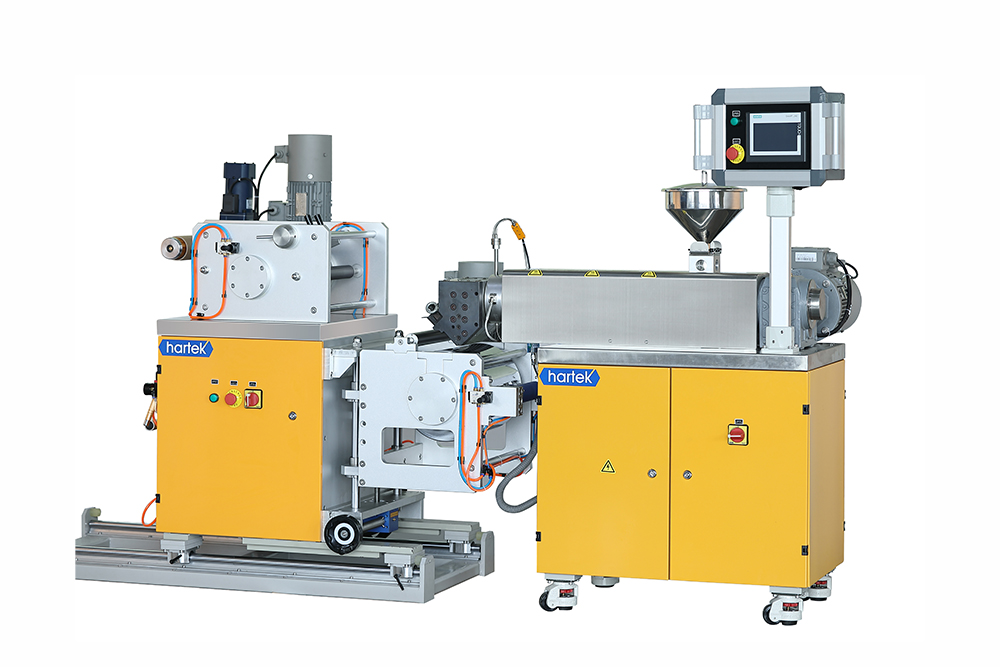
Hartek Technology Single-layer Cast Film Machine
• Multi-layer co-extrusion cast film pilot line: Composed of several small extruders and a small cast film machine, this line can produce multi-layer cast films with two, three, five, or even seven layers, making it ideal for the research and development of food packaging materials featuring multi-layer barrier properties.
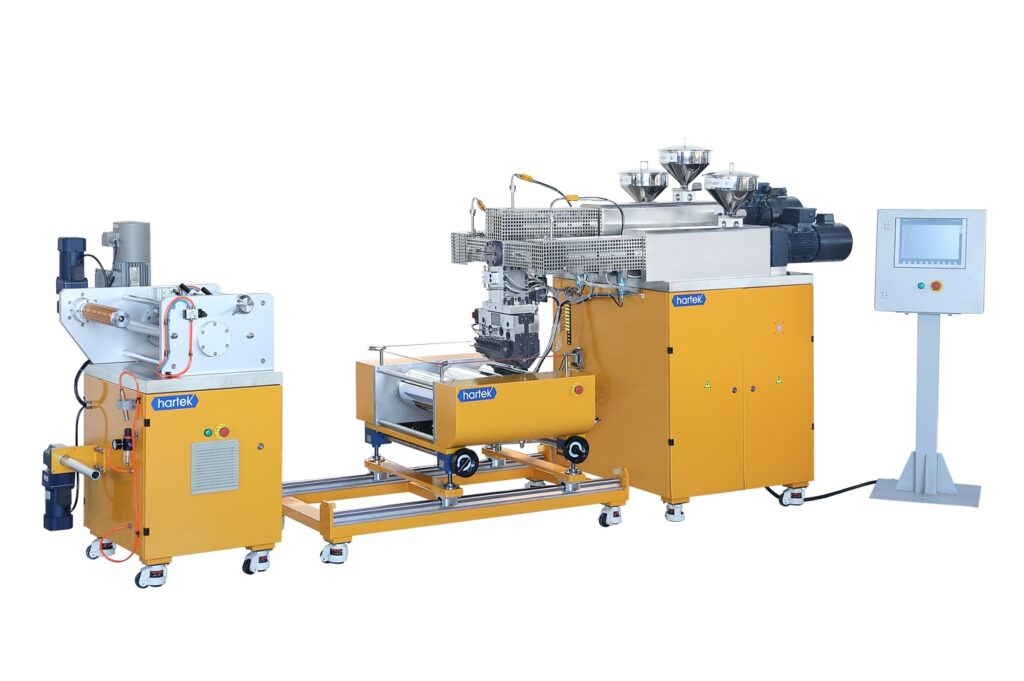
Hartek Technology Multi-layer Co-extrusion Cast Film Machine
III. Detailed Explanation of Key Selection Parameters
1. Screw Extrusion System: The Core of Plasticization and Mixing
• Screw diameter and length-to-diameter ratio (L/D):
Laboratory applications typically use screws with diameters ranging from 20 to 30 mm. A higher length-to-diameter ratio (e.g., from 28:1 to 40:1) can provide more thorough melting, mixing, and homogenization, which is especially important when processing formulations containing additives or color masterbatches.
• Rotational Speed and Control:
The rotational speed of laboratory cast-film machines typically ranges from 0 to 120 rpm. This wide and stable speed range helps accommodate the processing requirements of materials with varying rheological properties, from polyethylene (PE) to polyamide (PA).
2. Die and Cooling System: The Key to Film Formation Quality
• Die: A width of 200–300 mm is ideal. It is recommended to choose a die design that allows for quick die changes, so as to accommodate experimental requirements with different widths.
• Cooling roller: An efficient cooling system can rapidly and uniformly cool the film, helping to reduce internal stress and improve the film’s transparency and surface quality.
3. Control System: The Foundation of Precision and Stability
• Temperature control accuracy: The control accuracy of each temperature zone should reach ±1°C, as many food packaging materials are temperature-sensitive, and temperature fluctuations could lead to material degradation or changes in performance.
• Drive and Tension Control: A traction and winding system driven by a servo motor, coupled with precise tension control, is essential for ensuring uniform film thickness and smooth winding. It directly determines the reliability and repeatability of experimental data.
IV. Special Considerations for the Food Packaging Industry
1. Hygiene and Safety Design: All components that come into contact with materials shall be made of high-grade stainless steel, and the structural design shall feature no dead corners, ensuring easy cleaning and maintenance, thereby guaranteeing compliance and safety of the R&D materials from a hardware standpoint.
2. Multifunctional Requirements: Ensure the equipment can handle a wide range of food packaging materials, including PE, PP, PA, and PET. Additionally, supporting the addition of color masterbatches or functional masterbatches will greatly expand your R&D scope in the fields of sustainable and functional packaging.
3. Data Acquisition Function: Laboratory equipment should be equipped with a comprehensive data acquisition function capable of recording key parameters such as temperature, pressure, and velocity in real time. This enables researchers to analyze material performance, ensures that R&D decisions are based on solid data, and accelerates the innovation cycle.
V. Selection and Decision-Making Process
1. Requirements Analysis
• Clearly define the main types of food packaging under development.
• Will the future R&D focus be on upgrading single materials or innovating multi-layer composite structures?
• Assess the expected experimental frequency and periodicity requirements.
2. Budget Planning
• Within the budget, prioritize ensuring the performance and reliability of core components (screw extrusion system, die head, and control system).
• Comprehensively consider the energy consumption, maintenance costs, and technical support of equipment over its long-term operation, aiming for the highest return on investment throughout its entire lifecycle.
3. Supplier Assessment
• Choose a supplier with extensive experience in the food packaging industry, as they can provide more targeted solutions. Case.
• Assess the supplier’s technical support capabilities, including installation and commissioning, operational training, and after-sales service.
• Request suppliers to provide success stories of similar applications, and ideally arrange on-site visits or sample equipment trials to directly assess the equipment’s performance and ease of operation.
Conclusion
Selecting the right lab film-extrusion machine is a crucial step toward successful R&D of food packaging materials. By clearly identifying the specific needs of food packaging, understanding the characteristics of different equipment types, mastering key selection parameters, taking into account industry-specific requirements, and following a scientific selection process, companies can equip their R&D efforts with powerful innovation tools, enabling them to develop high-performance packaging materials that meet market demands more efficiently and accelerating the transition from laboratory findings to industrial-scale applications.