
Tel : +86-20 3483 7127
The rotation speed of the twin-screw is not the faster, the better. There is an optimal speed range, and an excessively high speed does more harm than good.
I. Benefits of Increasing Rotational Speed
1. Increased capacity: More material is conveyed and extruded per unit of time, leading to higher output;
2. Shear-mixing enhancement: As the screw’s linear velocity increases, the material experiences stronger shear, making it suitable for applications requiring thorough dispersion and compatible modification (filling, toughening, alloying).
3. Fast melt renewal: Slight improvement in degassing and venting efficiency.
II. The core issues caused by excessive speed (the drawbacks far outweigh the benefits)
1. Shear overheating and material degradation.
High-speed, high-shear processing generates significant frictional heat, causing thermosensitive materials such as PE, PP, PET, PVC, and PLA to easily yellow, undergo chain scission, and experience a dramatic drop in performance, resulting in bubbles, black spots, and brittle extrudate.
2. Torque overload and increased equipment wear and tear
Increased rotational speed → significantly higher screw torque and main motor current, accelerated wear of the gearbox, bearings, and screw barrel, increased risk of bearing, screw and threaded elements breaking, rapid aging and oil leakage in seals, and soaring maintenance costs.
3. Melt pressure surge
At high rotational speeds, the material is conveyed too quickly, causing a sudden surge in die pressure, which easily leads to die swelling, unstable material discharge, frequent clogging of the filter screen, and a significantly shortened mesh-changing cycle.
4. Large fluctuations in material discharge lead to deteriorated product quality
The residence time is shortened, leading to uneven material plasticization. Shear fluctuations are significant, causing loss of control over melt index, color variation, and wall thickness consistency. Granules produced have inconsistent particle sizes and tend to string or break during drawing.
5. Poor degassing and volatiles removal
The residence time of the material is drastically shortened, leaving insufficient time for small-molecule volatiles to be extracted, resulting in bubbles, off-odors, and excessive volatile content in the product.
6. Rising energy consumption
Unit production power consumption has increased, leading to higher production costs.
III. Disadvantages of Too Low Rotational Speed
Low production capacity and poor production efficiency;
Insufficient shear, poor filler dispersion, and poor alloy compatibility;
If materials stay in the system for too long, prolonged exposure to heat can also lead to thermal degradation.
IV. Select the logic correctly
1. Thermoplastic materials (PVC, PET, PLA, POM): Use medium-to-low rotational speeds to reduce shear heat and prioritize material stability.
2. High-filler, high-glass-fiber modification: Use medium rotor speed to balance dispersion and temperature control, ensuring the glass fibers are not excessively sheared.
3. Simple pelletizing and pure resin extrusion: Suitable for medium-to-high rotational speeds, focusing on production capacity.
4. High-volatility, high-evaporation systems: Use low to medium speeds and extend residence time to ensure efficient venting.
5. High-viscosity engineering plastics (PEEK, PPS): Use low rotational speeds to prevent torque overload and localized overheating that could lead to carbonization.
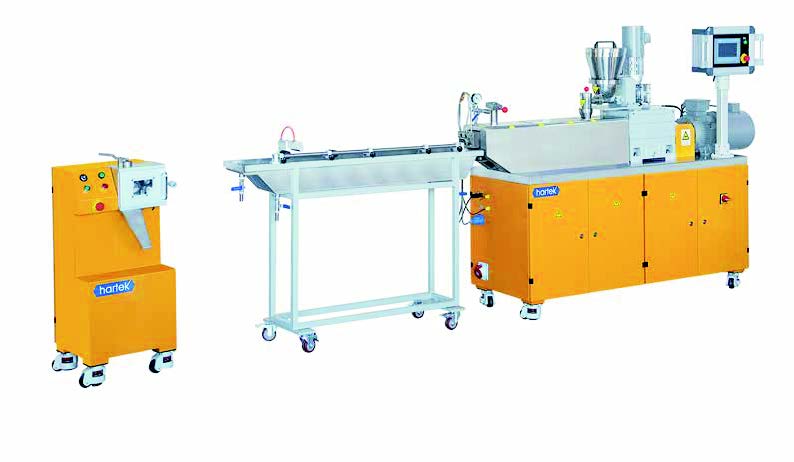
Summary
The twin-screw extruder has an optimal speed range: Under the conditions of sufficient plasticization, controllable temperature, and no overload on torque, appropriately increasing the screw speed can boost production. However, once the critical speed is exceeded, temperature, energy consumption, equipment performance, and product quality will all deteriorate—far from being true that "the faster, the better."
In actual production, it’s essential to coordinate and optimize the feed rate, barrel temperature, vacuum level, and screw geometry combination in tandem; simply increasing the screw speed alone is not advisable.