
Tel : +86-20 3483 7127
When it comes to pressing test specimens, laboratory tablet presses—also known as flat vulcanizers—are commonly used. During the pressing process, three types of process defects often arise: specimen delamination, air bubbles, and uneven thickness. These defects can compromise the accuracy and reproducibility of the specimen’s performance test results. Therefore, below we will analyze the causes of these defects based on the key steps in the tablet-pressing process and outline specific experimental adjustments that can be made to address them.
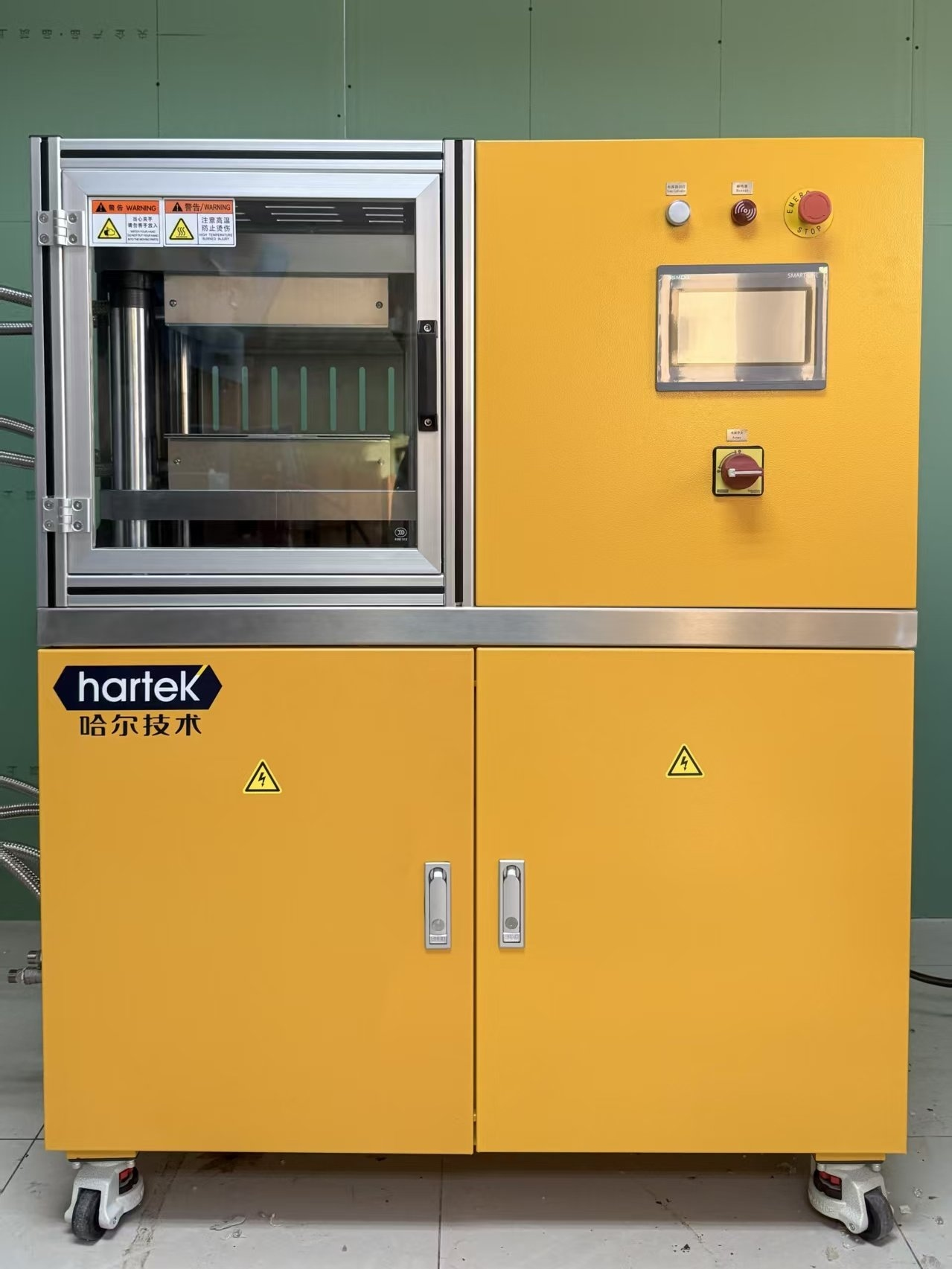
Do tablets exhibit layering, bubbles, or uneven thickness? Common problems—causes and solutions.
I. Causes of Delamination (Layer Separation) and Corresponding Countermeasures
Layering is manifested by obvious interfacial separation within the sheet material; this phenomenon often occurs between multi-layer fillers or between materials from different batches.
Main causes:
● Uneven loading and spreading: The material is not evenly distributed within the mold cavity, resulting in uneven pressure distribution after mold closing and insufficient fusion between layers.
● Temperature gradient and vulcanization are out of sync: The mold or vulcanization plate has an uneven temperature distribution, or during the heating process, the surface material reaches the vulcanization temperature and undergoes crosslinking before the interior does, thereby hindering the integration and bonding between the molten material inside and the surface layer.
● Insufficient venting: Air or volatile substances within the mold cavity fail to be effectively exhausted, creating a barrier between layers.
● Insufficient clamping pressure or short holding time: The clamping pressure is insufficient to allow the material to flow completely and fuse tightly, or the high-pressure holding time is too short, causing the material to partially set before it has fully bonded.
● Poor material compatibility: Differences in batches or formulations can lead to insufficient interfacial affinity.
Adjust strategy:
●Optimize the loading method: Preform the material into billets that closely match the shape and area of the mold cavity, ensuring that they are positioned centrally when placed into the mold cavity.
● Properly control the heating procedure: For thick products or systems with high filler content, a “two-step method” can be adopted: First, preheat at a lower temperature and low pressure (preheating pressure) for a certain period to allow the material to soften uniformly and achieve even temperature distribution; then, raise the temperature to the target vulcanization temperature and apply full pressure.
●Fully vent the air: During the initial pressurization stage, perform multiple “venting” operations—briefly releasing pressure to allow gases trapped in the mold cavity to escape, then quickly reapplying pressure.
● Ensure proper pressure and holding time: Verify that the equipment’s pressure gauge reading is accurate, and based on the material’s rheological properties, ensure sufficient holding time at full pressure.
●Check material conditions: Ensure uniform mixing. When using materials from different batches, re-melt and blend them thoroughly again.
II. Causes of Bubbles and Corresponding Countermeasures
Bubbles are closed cavities embedded within the specimen or distributed on its surface.
Main causes:
● Moisture or volatile components in the material: Moisture or low-molecular-weight volatiles in raw materials (especially hygroscopic polymers or moisture-absorbing fillers) vaporize at high temperatures.
● Improper degassing process: insufficient degassing cycles, improper timing (the material has partially vulcanized and lost its fluidity), or inadequate degassing stroke.
● Overly high vulcanization temperature: Excessively high temperatures cause certain materials (such as some additives) to rapidly decompose and release gases.
● Improper demolding method: After vulcanization, forcibly opening the mold before the internal pressure has fully dissipated can result in “popcorn-like” expanding air bubbles.
Adjust strategy:
● Perform rigorous pre-drying treatment: For polymers (such as nylon and PET) and fillers that are prone to moisture absorption, conduct thorough vacuum drying prior to sample preparation.
● Optimize the venting process: During the preheating stage, vent the material when it has reached a molten state but has not yet begun to crosslink. The venting action should be quick and the stroke should be sufficient.
● Adjust the temperature curve: Under the premise of ensuring that the material can flow sufficiently and cure normally, appropriately reduce the curing temperature.
● Standardize cooling and mold release operations: After vulcanization is complete, cool the mold while maintaining pressure (or allow it to cool naturally to a certain temperature or below). Only open the mold after the pressure inside the mold cavity has been reduced.
III. Causes of Thickness Variation and Corresponding Mitigation Strategies
Thickness variation refers to the situation where the thickness of different areas within the same sheet exceeds the allowable tolerance range.
Main causes:
● Poor mold parallelism: The mold itself is uneven or improperly installed, resulting in uneven gaps after the upper and lower molds are closed.
● Inaccurate loading amount: Too much or too little material is fed into the mold cavity, making it impossible to achieve the specified standard thickness.
● Uneven pressure distribution: The parallelism between the upper and lower heating plates of the flat vulcanizing machine is poor, or the force applied by the presser head is not perfectly vertical, resulting in an uneven distribution of clamping pressure.
● Poor material flow: The melt viscosity of the material is too high, or the curing speed is too fast, causing the material to lose its fluidity before the mold cavity is uniformly filled.
Adjust strategy:
● Calibrate molds and equipment: Regularly use feeler gauges to check the clearance around the perimeter of the mold after closing, ensuring parallelism. Also, inspect and calibrate the parallelism of the vulcanizing press’s hot plates.
● Precisely weigh the materials: Based on the mold cavity volume, material density, and target thickness, accurately calculate and weigh the amount of material to be added each time.
● Check the equipment’s operating status: Ensure that the hydraulic system is functioning properly, with no leaks and that pressure is applied evenly and stably.
● Adjust material and process parameters: For high-viscosity materials, you can appropriately increase the preheating temperature and extend the preheating time to improve fluidity; alternatively, adjust the flow aids and vulcanization system in the formulation.
Summary
When using a laboratory tablet press—or a flat vulcanizing machine—to prepare sample specimens, to avoid issues such as delamination, air bubbles, and uneven thickness, it is essential to precisely control the “temperature-time-pressure” parameters of the tabletting process, as well as to manage the material conditions, mold quality, and equipment settings. Moreover, experimental personnel must maintain tight control throughout the entire process—from raw material preparation and loading methods—every step, from setting process parameters to equipment maintenance, is meticulously documented, and each adjustment to the parameters is recorded. Ultimately, this ensures the preparation of standard test specimens that meet the target specifications.