
Tel : +86-20 3483 7127
When developing polymer films, a film-blowing experimental line is often used. Laboratory film-blowing machines come in both single-layer and multi-layer types. The R&D team needs to select the appropriate technology based on its specific requirements. So, how do you choose between a single-layer versus a multi-layer co-extrusion film-blowing experimental line, depending on your R&D needs? The following content provides an objective technical comparison based on the configuration differences between these two types.
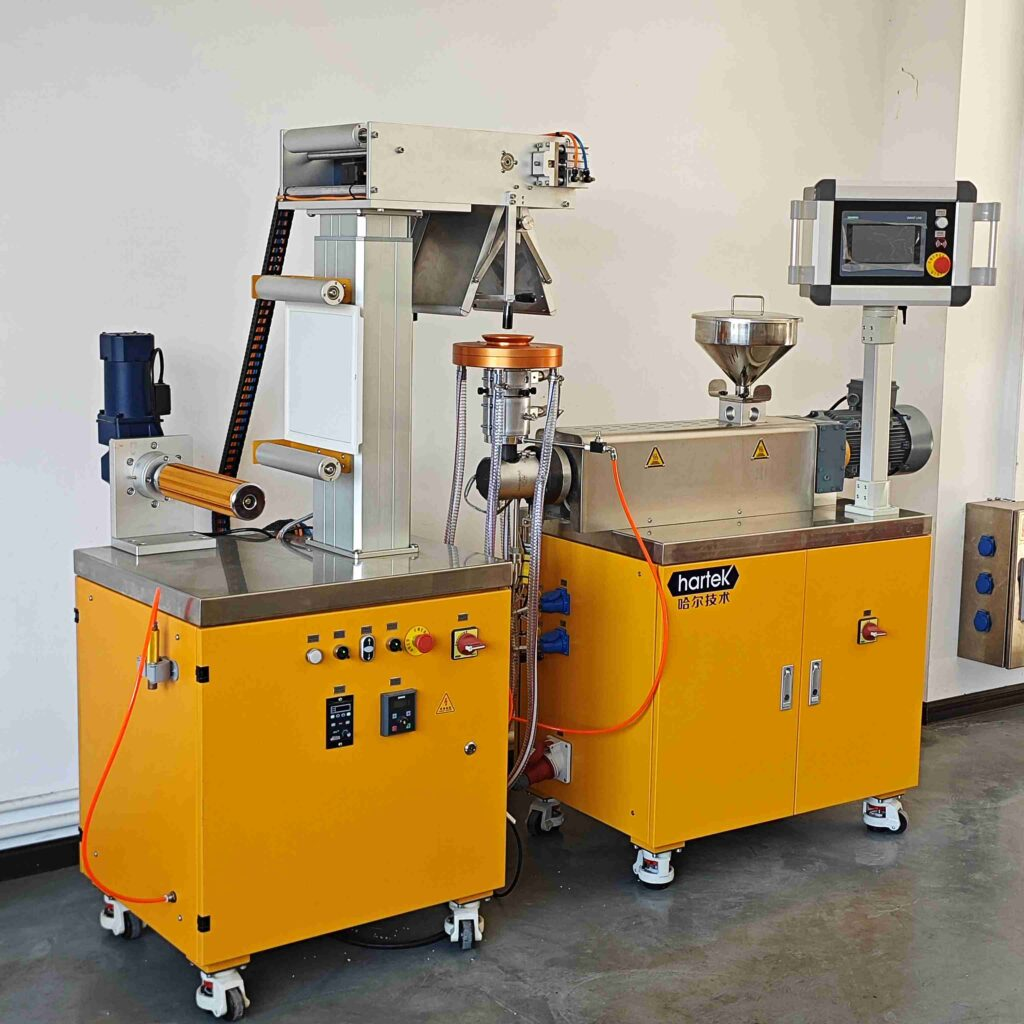
Single-layer blown film machine
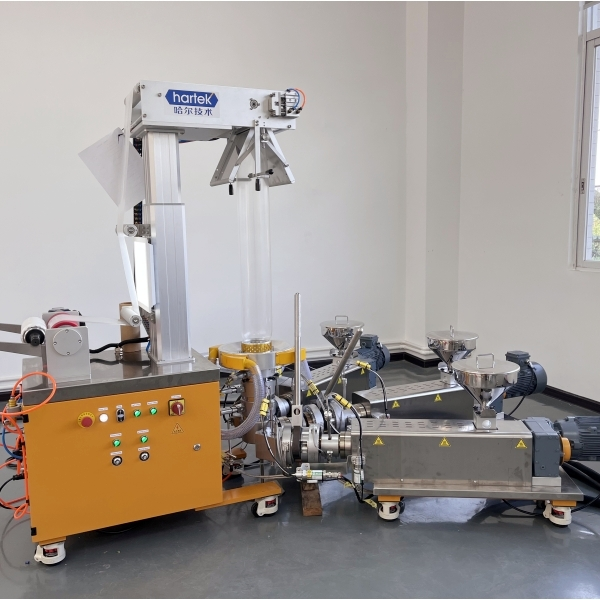
Multi-layer co-extrusion film blowing machine
I. Core Features and Application Scenarios of the Single-Layer Film Blowing Line
The structure of a single-stage experimental line typically consists of a single-screw extruder, a die, an air ring, a traction unit, and a winding unit.
1. Core advantages:
Cost and Efficiency:
The equipment’s acquisition and maintenance costs are significantly lower than those of multi-layer systems, making it more suitable for laboratories with limited budgets. Material replacement and cleaning are convenient, enabling rapid preliminary evaluations of film-forming properties for different formulations or new materials.
Process Variable Focus:
Concentrates on studying the melt flow, stretching, and crystallization behaviors of a single material system. This approach enables efficient exploration of how fundamental film-blowing process parameters—such as screw speed, extrusion temperature, blow-up ratio, and draw-down ratio—affect the mechanical and optical properties of films.
Simplicity and Reliability:
Low operational threshold and relatively easy-to-control process stability make it suitable for basic teaching, routine material performance testing, and simple product prototyping.
2. Major limitations:
It is impossible to prepare thin films with multilayer structures. It is difficult to evaluate studies involving adhesive layers, functional layers, or complex barrier structures.
II. Core Features and Application Scenarios of the Multi-Layer Co-Extrusion Film-Blowing Line
A multi-layer line is equipped with at least two extruders and uses a multi-layer co-extrusion die to combine layers, enabling the production of film structures with three, five, or even more layers.
1. Core advantages:
Structural Design and Simulation:
The core value lies in simulating multi-layer structures found in actual production (such as ABA, ABCBA), enabling the development of functional composite films with high-barrier properties (e.g., EVOH/PA layers), freshness-preserving capabilities, UV resistance, and other specialized functions. Key issues that can be investigated include layer thickness ratios, interfacial compatibility, and interlayer adhesion strength.
Resource Optimization Validation:
Allows verification of the “functional layer/substrate” design approach at the experimental scale—for example, co-extruding expensive high-barrier materials with low-cost polyolefins to optimize the cost structure while meeting performance requirements.
Study of Process Complexity:
This allows for an in-depth exploration of the merging behavior of multiple melt streams within the die, the control of interlayer stability, and the mutual influence among materials with different rheological properties during co-extrusion.
2. Main limitations:
Cost and Complexity:
Equipment investment, footprint, and energy consumption have increased exponentially. Operation and process debugging are complex, and material changes are time-consuming and labor-intensive.
High R&D capability requirements:
A deeper understanding of the rheological matching and interfacial interactions among materials at various layers is needed, placing higher demands on the theoretical and practical skills of R&D personnel.
III. Key Decision Points for Selection Based on R&D Needs
The selection should not be based on the advancedness of the equipment, but rather should be entirely aligned with the R&D objectives.
1. Typical scenarios for selecting a single-layer blown film production line:
Basic evaluation of new materials:
Conduct an initial screening of film-forming properties, as well as basic mechanical and thermal performance, for a novel resin or blend.
Basic process research:
Systematically investigate the processing-structure-property relationships in single-material systems and establish a foundational process database.
Development of specialized single-function membranes:
For example, focusing on researching the processing stability and performance optimization of single biodegradable films (such as PBAT/PLA).
Teaching and routine inspection:
Used to develop trainees’ basic operational skills or to verify the performance of incoming materials using the blown-film method.
2. Typical scenarios for selecting a multi-layer co-extrusion film-blowing experimental line:
Composite structure development:
Specifically aimed at developing thin films with two or more layers, such as a “barrier layer/adhesive layer/support layer” structure.
Interface and Compatibility Studies:
Core research topics include interlayer adhesion mechanisms, evaluation of compatibilizer effects, and control of interface stability.
Pilot Production and Simulation:
The experimental stage must simulate, as realistically as possible, the complex structures of future industrial production to provide direct data for scale-up production.
Research on Resource-Efficient Utilization:
Verifying the feasibility of designing functional masterbatches or materials to be placed exclusively in specific thin layers.
When selecting an extrusion film-line model, it’s essential to define the target based on the product being developed in the R&D project. If the product consists of a single material or if the focus is solely on the intrinsic properties of the base material, then a single-layer line suitable for basic validation should be chosen to avoid over-specification. On the other hand, if the core of the R&D effort lies in “structural design” and “interface control,” a multi-layer line would be more appropriate. For comprehensive research institutions, a highly flexible single-layer line can be selected for extensive preliminary screening and fundamental research, while simultaneously equipping a modularly designed multi-layer line—such as a three-layer configuration—for in-depth structural development. This approach ensures optimal allocation of R&D resources.