
Tel : +86-20 3483 7127
With the rapid development of new energy vehicles, the manufacturing processes for lithium batteries are undergoing a new transformation. The Dry Electrode process, as an emerging method for preparing positive and negative electrodes, has attracted significant attention due to its environmental friendliness, high energy efficiency, and suitability for new systems such as solid-state batteries.
I. Dry Electrodes and Solid-State Batteries: A Green Solution for the Future
Traditional lithium battery electrode preparation relies on solvent coating and drying processes. For instance, binders are dissolved using NMP (N-Methyl-2-pyrrolidone), followed by slurry mixing, coating, and drying. This process flow is not only energy-intensive and complex but also involves issues related to solvent recovery and environmental emissions.
In contrast, dry electrode technology completely eliminates solvents and drying processes. It involves directly mixing powder materials (active substances, conductive agents, and binders) and then applying the mixture onto a current collector (such as aluminum or copper foil) through pressing or other mechanical methods.
Compared to traditional processes, dry electrode technology offers the following advantages:
- Lower Energy Consumption: Eliminates the solvent drying stage, saving significant thermal energy.
- Simplified Equipment: Shorter production lines and smaller footprint.
- Environmentally Friendly: No emission of harmful solvents, enabling green manufacturing.
- Compatibility with Solid-State Batteries: Better suited for the high-pressure, dense electrode requirements of all-solid-state batteries.
Especially in promoting the industrialization of all-solid-state lithium batteries, dry electrode technology is regarded as a key process due to its support for high energy density and high interface stability.
II. The Core Role of Twin-Screw Extruders in Dry Electrode Processes
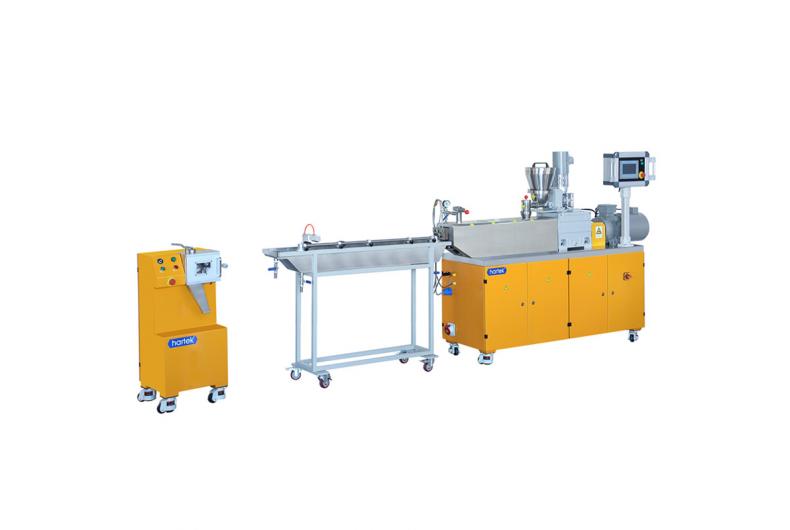
Although dry electrodes eliminate liquid solvents, they impose higher requirements on mixing uniformity, dispersion, and formability of materials. Traditional dry powder mixing or drum blending methods struggle to meet industrial standards for consistency and density. In this context, the Twin-Screw Extruder provides an efficient, controllable, and continuous solution.
1. Efficient Dry Mixing and Melt Dispersion
Key materials for dry electrodes, such as NCM, Lithium Iron Phosphate (LFP), carbon black, Carbon Nanotubes (CNT), PTFE, and PVDF, require thorough mixing under solvent-free conditions.
The characteristics of twin-screw extruders include:
- Utilizing high shear forces and strong kneading structures to uniformly distribute the binder onto the surface of active materials and conductive agents.
- Enabling partial melting of thermoplastic binders at set temperatures to achieve a "plasticized" mixing effect.
- Preventing powder agglomeration, thereby improving electrode consistency and the connectivity of conductive pathways.
2. Granulation Pretreatment to Optimize Pressing Performance
The mixed material is discharged through the extrusion section and cut into pellets, forming particles with stable size and good flowability. This is crucial for dry pressing:
- Improves material filling uniformity and bulk density.
- Reduces the risk of cracking and voids during pressing.
- Facilitates the production of high-density electrodes, meeting the interface contact requirements of solid-state batteries.
3. Flexible Platform for Formula Verification and Process Optimization
Laboratory-scale twin-screw extruders support multi-zone temperature control, interchangeable screw configurations, and continuous speed adjustment, making them an ideal platform for dry electrode formula development:
- Rapid switching between different material systems (e.g., sulfide/oxide solid electrolytes with different binders).
- Studying the effects of temperature, shear, and residence time on mixing quality and electrode performance.
- Equipped with online temperature measurement and data acquisition systems for easy process tracing.

III. Typical Application Configurations and Cases
|
Item |
Parameters |
|
Screw Diameter |
16mm / 20mm (Laboratory and Pilot Scale) |
|
Temperature Control Range |
Room Temperature ~ 300°C, Multi-zone independent control |
|
Screw Structure |
Modular design (Kneading, Conveying, Venting sections) |
|
Feeding Method |
Powder feeder with loss-in-weight control support |
|
Discharge Method |
Options include hot cutting, air cooling, and water cooling granulation |
|
Control System |
PLC + HMI interface with data recording capabilities |
IV. Conclusion
The dry electrode process is leading lithium battery manufacturing toward a greener, more efficient, and lower-cost future. As the "front-end hub" of this core process, twin-screw extrusion granulation equipment not only improves mixing quality but also drives the advancement of dry electrode preparation towards industrialization and automation.
Whether in the early stages of material formula development or in pilot lines and future mass production lines, the twin-screw extruder will play an irreplaceable role.